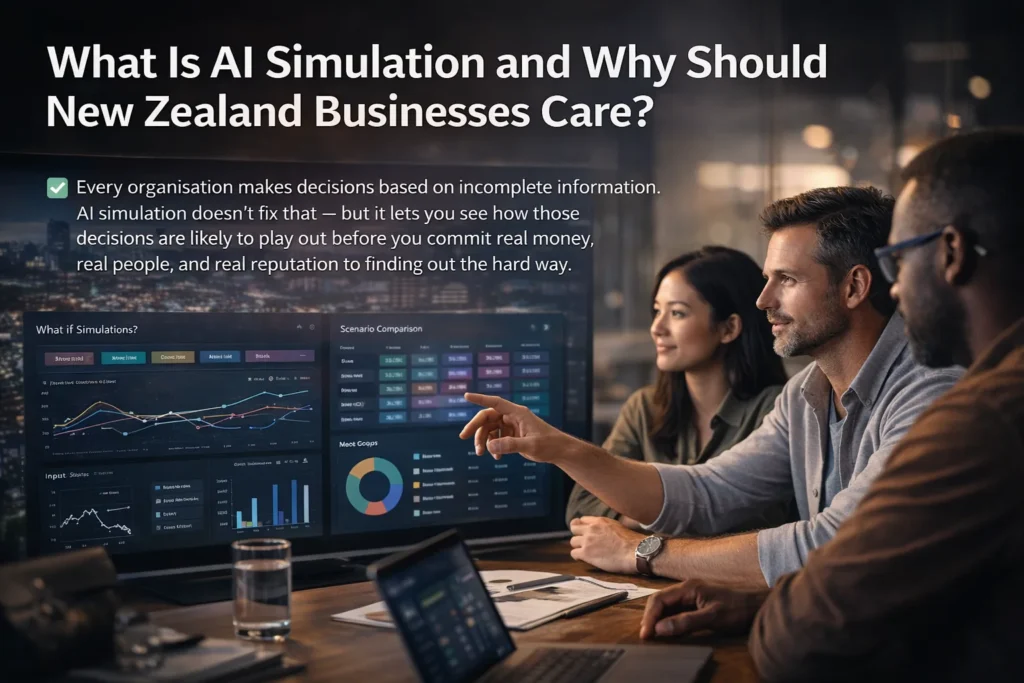
Every organisation makes decisions based on incomplete information. AI simulation doesn’t fix that — but it lets you see how those decisions are likely to play out before you commit real money, real people, and real reputation to finding out the hard way.
There’s a gap in how most New Zealand businesses make decisions, and it’s not where people think it is.
The gap isn’t in strategy. Most organisations have more strategy than they can execute. It’s not in data either — there’s plenty of it, even if it’s messy. And it’s not in leadership intent. Most leaders want to make good decisions.
The gap is between deciding and knowing what happens next.
A council approves a rates increase. What happens to public trust? Which community groups mobilise? Does the backlash hit the mayor’s office or the front-desk staff first?
A business restructures its customer service team. Where do the bottlenecks appear? Which processes break? Does the workload redistribute evenly or crush the two people who already carry everything?
An organisation rolls out a new system. Who adopts it? Who works around it? Where does the training fail to translate into changed behaviour?
These are the questions that matter most, and they’re almost always answered by guessing, by hoping, or by finding out after the damage is done.
AI simulation exists to answer them before that point.
AI Simulation in Plain Language
Strip away the jargon and AI simulation is a straightforward concept: you build a model of how your organisation, community, or system actually works, then you run scenarios through it to see what’s likely to happen.
It’s not prediction. Nobody is claiming to tell the future. It’s structured exploration of consequences — a way to ask “what if” questions against a realistic model of your environment rather than against assumptions in someone’s head.
Traditional planning does this informally. Leaders sit in a room, discuss options, and mentally model the likely outcomes. The problem is that mental models are limited by individual experience, biased by optimism, and invisible to everyone else in the room. Two people can look at the same proposal and have completely different assumptions about how it will land, and neither knows the other’s assumptions exist.
AI simulation makes those assumptions explicit. It builds them into a model you can see, test, challenge, and refine. Then it runs scenarios across that model — not once, but many times, under different conditions — to show you the range of likely outcomes rather than the single outcome you were hoping for.
The AI component accelerates what would otherwise take weeks of manual analysis. It synthesises messy inputs — interview data, operational metrics, stakeholder feedback, financial constraints — into a coherent model faster than any team could do manually. It identifies patterns and second-order effects that humans miss because we’re not built to hold dozens of interacting variables in our heads simultaneously.
But the human stays in charge. AI doesn’t make the decision. It shows you what your decisions are likely to produce, so you can adjust before committing.
Why This Matters Now for New Zealand Businesses
Three pressures are converging on NZ businesses and public organisations that make AI simulation relevant in a way it wasn’t even two years ago.
The first is the cost of getting decisions wrong. Margins are tighter. Budgets are constrained. Councils are under pressure from ratepayers. Businesses can’t afford the kind of failed transformation programmes that larger economies absorb as the cost of doing business. In New Zealand, a botched restructure or a system implementation that nobody adopts doesn’t just waste money — it can set an organisation back years.
The second is the pace of change being demanded. AI adoption, digital transformation, service redesign, workforce restructuring — organisations are being asked to change multiple things simultaneously, often without a clear picture of how those changes interact. Each initiative might make sense in isolation. Stacked together, they can overwhelm the people and systems expected to carry them.
The third is the trust environment. Public organisations in particular are operating in a context where community trust is fragile, media scrutiny is intense, and the consequences of a decision that “blows up” publicly are severe. Councils making decisions about rates, service levels, facility closures, or district plan changes need to understand not just the operational impact but the civic impact — how communities will respond, where resistance will form, and what narratives will take hold.
AI simulation addresses all three by letting you test before you commit. Not in a theoretical way — in a way that’s grounded in your actual data, your actual constraints, and your actual operating environment.
What AI Simulation Actually Looks Like in Practice
This isn’t a single tool or platform. It’s an approach to decision-making that uses AI-supported models to explore outcomes. In practice, it works across several distinct use cases.
Organisational reality mapping. Before you can simulate change, you need to know how things actually work today. Not the org chart version. Not the process documentation. The real version — where work gets stuck, where handoffs fail, where decisions stall, and where the informal workarounds live that keep things running despite the official process. AI helps synthesise interviews, operational data, and workflow analysis into a realistic picture of your operating model. This becomes the baseline that everything else is tested against.
Change impact simulation. You’re planning a restructure, a new system, an automation programme, or a shift in service delivery. Before it goes live, you model it against the operational baseline. Where does workload shift? Which teams hit capacity? Where does the change create friction with other processes? What happens to service levels during the transition? These aren’t hypothetical questions — they’re modelled against the reality of your organisation as it exists today, not as the project plan assumes it exists.
Stakeholder and civic simulation. For councils and public organisations, decisions don’t just have operational impacts — they have community impacts. AI simulation can model how different community segments are likely to respond to a proposal, where trust is fragile, which narratives will gain traction, and where engagement needs to be focused to build legitimacy rather than just tick a box. This is civic intelligence, not opinion polling.
Decision stress-testing. Some decisions are too expensive to “learn as you go.” Before committing to a major investment, policy change, or transformation programme, you can run extended what-if simulations that stress-test the decision against operational constraints, funding scenarios, adoption dynamics, and stakeholder behaviour over time. You see not just the best case, but the range of likely cases — including the ones nobody wants to talk about in the planning meeting.
Scenario comparison. Most decisions aren’t binary. There are usually multiple options, and the trade-offs between them are complex. AI simulation lets you model several scenarios side by side, with explicit assumptions and transparent reasoning, so leadership teams can compare options on evidence rather than instinct.
What AI Simulation Is Not
It’s worth being clear about the boundaries, because the term “simulation” carries expectations from other fields that don’t apply here.
AI simulation for business decisions is not engineering-grade modelling. It’s not trying to predict outcomes to three decimal places. The goal is decision-ready insight — enough clarity to make better choices, not enough precision to eliminate uncertainty entirely. Uncertainty doesn’t disappear. It becomes visible and manageable.
It’s not a platform you buy and operate. At least not in the way we use it. The simulation is a consulting methodology supported by AI, not a software product. Clients don’t need to learn a tool or manage a system. They engage with the insights and the evidence, not the machinery behind it.
It’s not a replacement for human judgement. This is important. AI simulation surfaces patterns, consequences, and trade-offs that are hard to see manually. But the decision remains with the humans who understand the context, relationships, politics, and values that no model fully captures. The simulation informs. Leaders decide.
And it’s not a crystal ball. It shows you likely consequences based on the best available evidence and explicit assumptions. When those assumptions change, the model changes. That’s a feature, not a flaw — it means the reasoning is always traceable and challengeable.
The NZ-Specific Opportunity
New Zealand has some characteristics that make AI simulation particularly valuable here.
We’re small enough that decisions have outsized impact. A restructure in a 200-person council affects a disproportionate number of the community it serves. A botched system implementation in a regional business doesn’t just lose money — it can lose the institutional knowledge of the people who leave because of it. The margin for error is smaller, which makes testing decisions before committing to them more valuable.
We have a concentrated stakeholder environment. In most New Zealand communities, the people affected by a decision and the people making it are separated by one or two degrees. This creates accountability, which is good, but it also creates pressure to get things right the first time. Simulation helps with that.
Our public sector is being pushed to adopt AI while still figuring out how. The government’s own data shows 80% of identified AI projects are stuck in planning. AI simulation offers a way for organisations to explore AI adoption scenarios — where automation will genuinely remove work versus where it shifts problems elsewhere — before committing resources to implementations that might not deliver.
And our businesses are under pressure to change faster with fewer resources. When you can’t afford a failed transformation, being able to test the change in a model before testing it on your people is a genuine competitive advantage.
Where to Start
AI simulation sounds like something reserved for large enterprises with large budgets. It doesn’t have to be.
A focused simulation engagement can be scoped around a single decision, a single service area, or a single change programme. It doesn’t require perfect data — it works with what exists and fills gaps through targeted discovery. And because the simulation accelerates what would otherwise be weeks of manual analysis, it often costs less than the alternative: making the decision blind and dealing with the consequences.
The starting point is almost always understanding reality. What’s actually happening in your organisation today? Where does work get stuck? Where are the constraints? What assumptions are you making about capacity, capability, and readiness that might not be true?
Once that baseline exists, everything else — change simulation, scenario comparison, stakeholder modelling, decision stress-testing — becomes possible. And every decision after that is made against evidence rather than optimism.
The organisations that will navigate the next few years most successfully won’t be the ones with the best strategies. They’ll be the ones that tested those strategies against reality before committing to them.
Steve Wilson is the founder of Ministry of Insights and Changeable, based in Inglewood, Taranaki. The MOI Lab System uses AI-supported simulation to help councils, SMEs, and complex organisations make better decisions with less regret.