A case for continuous, small-scale automation cycles
For more than two decades, organisations have invested in large, multi‑year “digital transformation” programmes. They usually start with energy, ambition, and executive sponsorship. They are launched with glossy roadmaps, new platforms, and ambitious promises about efficiency, insight, and cultural change.
And then, quietly, many of them stall.
Budgets blow out. Timelines slip. Systems are delivered that only partially fit reality. Staff learn to work around them. Leadership changes. Priorities shift. What was meant to transform the organisation becomes another expensive layer sitting on top of old processes.
At Ministry of Insights, we see this pattern repeatedly. Not because leaders are careless. Not because teams are incompetent. But because the traditional “transformation project” model is structurally misaligned with how organisations actually work.
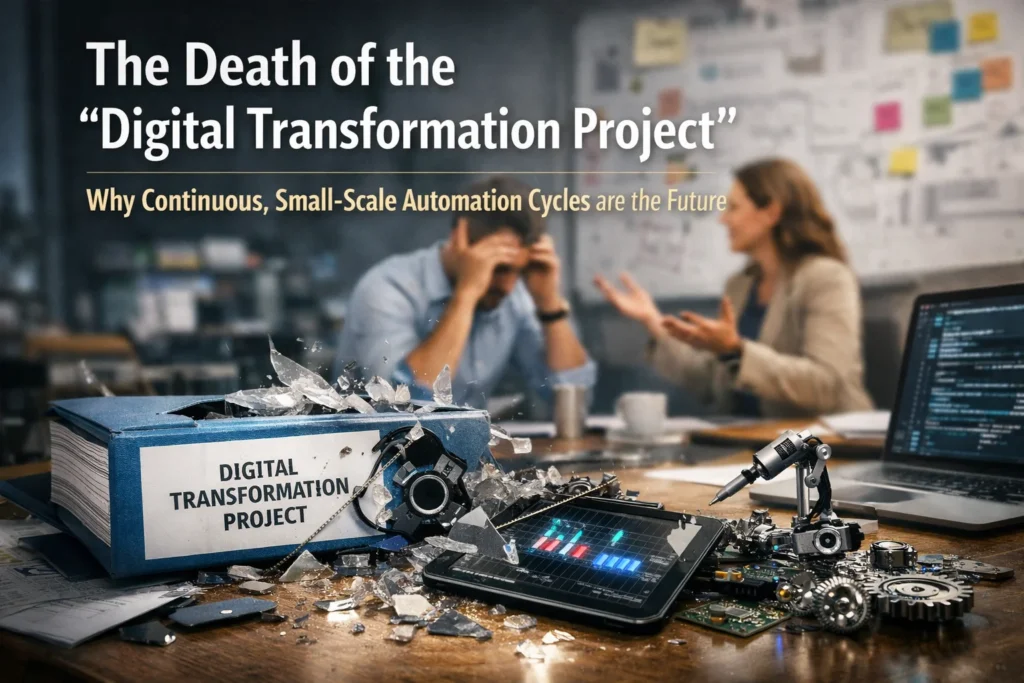
It is time to acknowledge that the era of the big digital transformation project is ending.
What is replacing it is something quieter, more practical, and far more effective: continuous, small‑scale automation and improvement cycles.
Why large transformation programmes struggle
Most major transformation initiatives share the same underlying assumptions.
They assume that processes can be fully mapped upfront. They assume that future requirements can be predicted with reasonable accuracy. They assume that once a new system is delivered, behaviour will follow. They assume that organisational reality is stable enough to support a multi‑year redesign.
In practice, none of these assumptions hold for long.
Processes evolve as soon as they are documented. Policy settings shift. Market conditions change. New regulations appear. Key staff leave. Informal workarounds emerge. Data quality issues surface late. Political dynamics reshape priorities.
By the time a major system is ready for deployment, the environment it was designed for often no longer exists.
This creates three systemic problems.
First, the gap between “designed work” and “real work” widens. Formal workflows look elegant on paper. Actual workflows remain messy, adaptive, and human. Large systems struggle to bridge this gap.
Second, risk accumulates invisibly. Because delivery is staged over years, problems are often detected late, when they are expensive to fix and politically difficult to admit.
Third, learning is delayed. Teams do not get fast feedback on whether changes are helping or harming performance. Improvement becomes theoretical rather than evidence‑based.
The result is a cycle of optimism, disappointment, and reinvention.
The hidden cost of “big bang” change
Large transformation projects are usually justified on scale. Leaders are told that only major investment can deliver major results. Fragmented improvement is framed as inefficient or timid.
But scale comes with hidden costs.
When change is concentrated into a single programme, organisations lose flexibility. Every adjustment becomes a negotiation. Every deviation becomes a risk. Local innovation is suppressed in favour of central consistency.
Staff become cautious. They wait for “the new system” rather than improving what exists. They defer problems instead of solving them. Capability atrophies while dependency grows.
Over time, the organisation becomes less adaptive, not more.
Ironically, programmes designed to modernise often reduce resilience.
What actually works: continuous automation cycles
High‑performing organisations rarely improve through massive redesign. They improve through constant, disciplined, small‑scale experimentation.
In this model, change is not treated as a project. It is treated as an operating system.
Small problems are identified early. Limited solutions are designed quickly. Automation is introduced in narrow contexts. Results are measured. Adjustments are made. Successful patterns are scaled. Failed ideas are retired with minimal cost.
This approach has several advantages.
First, learning is immediate. Teams see within weeks, not years, whether something works.
Second, risk is contained. Failures are local and reversible. They do not threaten organisational stability.
Third, capability grows internally. Staff learn how to improve systems, not just how to use them.
Fourth, solutions remain aligned with reality. Because change is continuous, designs evolve alongside actual work practices.
Over time, hundreds of small improvements compound into significant transformation.
Without the trauma.
Automation as augmentation, not replacement
A common fear in digital initiatives is that automation is primarily about removing people from processes.
In practice, the most valuable automation does something different. It removes friction, not judgment. It reduces manual effort, not accountability. It supports decision‑making, not substitutes for it.
Small‑scale automation is especially powerful in this regard.
Instead of replacing entire functions, it targets specific pain points: repetitive data handling, fragmented reporting, inconsistent approvals, manual reconciliations, duplicated documentation.
Each improvement frees cognitive capacity. Each reduces error. Each improves visibility.
Over time, people spend less energy managing systems and more energy managing outcomes.
Governance in a continuous model
One objection to incremental change is governance. Leaders worry that decentralised automation will lead to inconsistency, compliance risks, and uncontrolled technology sprawl.
These risks are real. But they are not solved by centralising everything into a single programme.
They are solved by shifting governance upstream.
In a continuous model, governance focuses on standards, guardrails, and decision criteria rather than rigid designs.
Clear principles are established for data use, privacy, security, validation, documentation, and accountability. Automation initiatives are reviewed against these principles early. Risk is assessed in small units, not retrospectively at scale.
This produces stronger control, not weaker.
Because issues are visible while they are still manageable.
The role of leadership
Moving away from large transformation projects requires a different kind of leadership.
Leaders must shift from sponsors of programmes to stewards of learning systems.
Instead of asking, “When will the transformation be finished?” they ask, “What did we learn this quarter?”
Instead of demanding certainty upfront, they invest in fast feedback.
Instead of rewarding compliance with plans, they reward evidence‑based adaptation.
This does not mean abandoning ambition. It means pursuing it through disciplined iteration rather than grand design.
How Ministry of Insights supports this shift
At Ministry of Insights, our work is built around this continuous improvement philosophy.
Through our simulation and decision‑assurance frameworks, we help organisations test changes before they scale. We model operational impacts, capacity constraints, behavioural responses, and governance risks in advance.
Rather than delivering static roadmaps, we help clients build living systems for experimentation, learning, and adjustment.
Our focus is not on installing tools. It is on strengthening decision quality.
Small, well‑designed changes. Tested rigorously. Governed intelligently. Scaled responsibly.
From projects to practice
The idea of “finishing” digital transformation belongs to another era.
Modern organisations operate in permanent uncertainty. Technology evolves continuously. Expectations shift rapidly. Risks emerge unexpectedly.
In this environment, resilience comes from capability, not completion.
The organisations that will thrive are not those with the biggest programmes. They are those with the strongest improvement muscles.
They treat automation as practice, not event.
They replace transformation projects with transformation habits.
And in doing so, they build systems that evolve as fast as the world around them.
Ministry of Insights
Helping organisations turn evidence into confident action through continuous, governed, human‑centred innovation.