

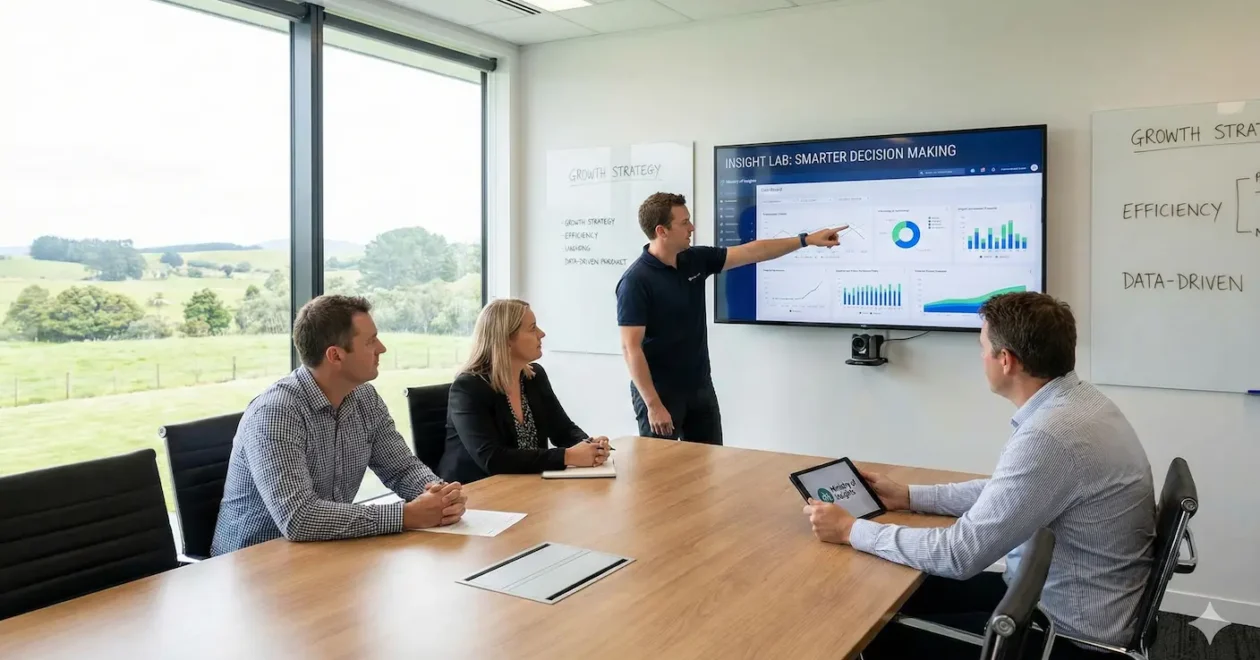
Smarter Decision Making for a Growing SME
Client
A New Zealand based SME operating in a competitive service industry. The business employed approximately 25 staff and was experiencing rapid growth, increasing operational complexity, and rising cost pressures.
Challenge
The business had reached a point where “gut feel” decision making was no longer enough. Key challenges included:
- Inconsistent performance between teams
- Limited visibility across financial, operational, and customer data
- Reactive decision making driven by short-term pressure rather than strategy
- Difficulty prioritising investment in people, systems, and process improvements
The leadership team needed clearer insight into where the business was leaking time, money, and opportunity.
Approach
The business partnered with Ministry of Insights to run a pilot of Insight Lab, an AI-supported decision and performance environment designed specifically for SMEs.
Working closely with the leadership team, Ministry of Insights:
- Mapped existing business processes and performance drivers
- Structured fragmented data from finance, operations, and customer systems
- Built scenario models to test growth, pricing, staffing, and system investment options
- Simulated operational and financial outcomes across multiple time horizons
Insight Lab turned previously disconnected information into a coherent decision framework.
Outcomes
Through the pilot, the business was able to:
- Identify unprofitable service lines that were hidden within blended reporting
- Reprioritise team effort toward higher margin work
- Reduce operational friction through targeted process changes
- Improve forecasting accuracy and cashflow visibility
- Create a more confident, evidence-based leadership rhythm
Several decisions that had been debated internally for months were resolved in weeks once they could be tested and visualised.
Value Delivered
Insight Lab delivered practical, measurable value:
- Faster, higher confidence decision making
- Reduced reliance on instinct alone
- Stronger alignment between finance, operations, and strategy
- A sustainable framework for ongoing business improvement
The organisation moved from reactive firefighting to proactive, structured growth.
Why It Worked
The engagement worked because:
- Business leaders remained in control of decisions
- AI was used to test assumptions, not replace leadership
- The focus was on clarity, not complexity