
There is a very specific dance playing out in organisations right now.
Someone in leadership says, “We should do something about AI.”
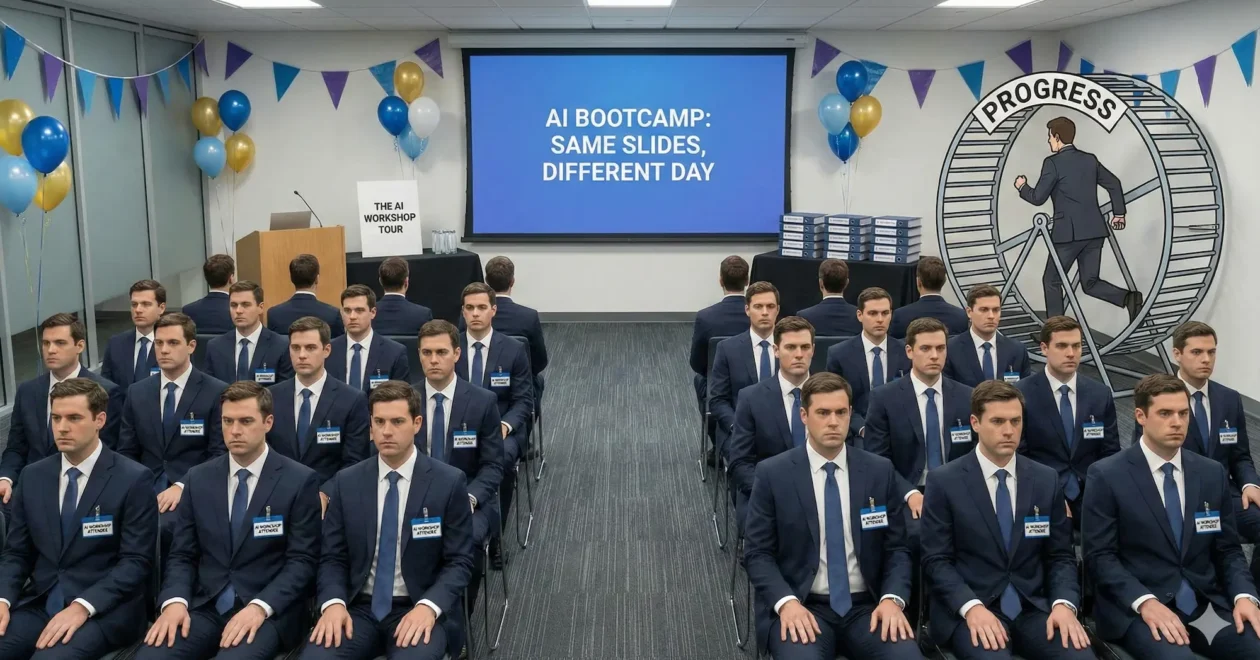
Two weeks later, everyone’s calendar is full of AI workshops. Same faces. Same rooms. Same slide decks with slightly different titles.
“AI Bootcamp.”
“AI 101.”
“AI for Leaders.”
Different name, same outcome. A steady drip of AI events. Almost no actual change.
That is not an AI strategy. That is a tour.
The AI Workshop Merchant Playbook
1. The Roadshow That Never Lands
New sessions keep arriving, but they never connect to a roadmap, a backlog, or any real workflow changes.
The organisation stays in permanent “getting ready” mode and never moves into “getting things done.”
2. The Spark With No Fuse
Workshops generate interest and sticky notes. People get curious, even excited.
Then there is no intake process, no way to prioritise ideas, and no link to the change portfolio.
The energy just evaporates.
3. The Slide Deck Recycling Plant
You get the same AI history timeline, the same generic examples, the same list of “cool prompts to try.”
The output is content, not capability.
Why Organisations Keep Buying Workshops
Workshops Feel Safe
Everyone knows how to attend a workshop.
No one has to change a KPI, rewrite a process, or touch the org chart.
Workshops Look Like Progress
Leaders can proudly say, “We ran 12 AI workshops this quarter.”
No one asks, “Cool, which workflows are different now?”
Workshops Delay Hard Conversations
Workshops are a great way to avoid talking about investment, data quality, technical debt, role changes, and governance.
You get the buzz of activity without the discomfort of decisions.
Workshops Are Fine. Workshops As Strategy Is Not.
If you actually want AI capability rather than AI theatre, you have to touch four layers:
- Governance
- Workflows
- Data
- Automation and integration
Layer 1: Governance
Set rules for safe AI use.
Decide who can do what.
Create intake flows for ideas and experiments.
Line it all up with privacy, security, and risk.
Most workshops never produce a single governance artifact you can actually use.
Layer 2: Workflows
Tie AI to real work.
Map how work happens today.
Redesign the process.
Decide which steps are human, which are AI assisted, and which can be automated.
Update SOPs and training.
This is the unglamorous part, so workshops usually skim past it.
Layer 3: Data
Connect AI to your internal documents, product information, and knowledge bases.
Sort out indexing, access controls, retention, and update rules.
If no one mentions permissions, source of truth, or update cadence, it is not a serious AI conversation.
Layer 4: Automation and Integration
Move beyond “type a prompt and hope.”
Embed AI into the tools you already use: CRM, service desk, email, document systems, pipelines.
Design flows that run the same way every time, not just “when someone remembers to try ChatGPT.”
Spotting Workshop Merchants
A few questions will tell you what you are buying:
- What concrete artefacts will we have at the end?
- Which workflows will run differently because of this?
- How do you handle governance, data, and integration in your work?
- Who in our organisation will own what you deliver?
If the answers are all about “awareness” and “mindset” and “the journey,” you are probably booking another stop on the tour.
What To Ask For Instead
Instead of another generic AI inspiration session, ask for:
- A one page AI governance starter pack you can actually adopt and iterate
- Mapping and redesign of three high value workflows, end to end
- One small, safe, measurable pilot that touches real data and real work
- A basic prompt and pattern library, with named owners and a plan to keep it updated
Final Thought
If you can list ten AI workshops you have attended, but you cannot name one changed workflow, policy, or automation, you are in “death by AI workshop” territory.
Real capability comes from fewer sessions and more systems.